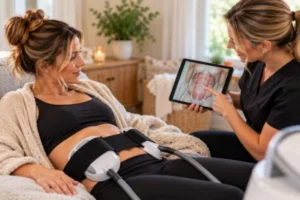

Diastasis Recti After Pregnancy: Exercise, Recovery, Belly Bands & Nutrition
Pregnancy brings significant changes to the abdominal wall.
As your baby grows, the abdominal muscles and the connective tissue between them naturally stretch to accommodate your changing body. This can result in a separation between the two sides of the rectus abdominis muscles, commonly known as diastasis recti or abdominal separation.
If you notice a gap, softness or bulging around the middle of your abdomen after having a baby, it doesn’t necessarily mean something has gone wrong.
Abdominal separation is common during pregnancy and often improves naturally during the weeks following birth.
But what should you do during those early weeks? Can exercise help? Does nutrition make a difference? And what about postpartum belly bands?
This guide looks at diastasis recti during pregnancy and after birth, with an emphasis on gradual recovery and knowing when to seek professional assessment.
What Is Diastasis Recti?

The rectus abdominis muscles run vertically down the front of the abdomen.
A band of connective tissue called the linea alba runs between them.
During pregnancy, the growing uterus places increasing demand on the abdominal wall. The muscles and connective tissue stretch, and the distance between the two sides of the rectus abdominis can increase.
This separation is often referred to as:
- Diastasis recti
- Diastasis rectus abdominis
- Abdominal separation
- Diastasis of the abdominal muscles
Some degree of separation during pregnancy is normal.
After birth, the abdominal wall begins adapting again, and the separation may gradually reduce.
Why Does Diastasis Recti Happen During Pregnancy?
Diastasis recti shouldn’t simply be viewed as something you have caused by exercising incorrectly, eating the wrong foods or failing to support your bump.
Your abdomen has to accommodate a growing baby.
As pregnancy progresses, the abdominal wall stretches considerably.
Several factors may influence how someone’s abdominal wall changes during pregnancy and how it recovers afterwards, but there isn’t a guaranteed way to prevent abdominal separation.
That means pregnant women shouldn’t be made to feel that developing diastasis recti represents a failure to exercise correctly or look after their bodies.
Can You Prevent Diastasis Recti During Pregnancy?
No reliable exercise, diet, or product can guarantee you will not develop abdominal separation during pregnancy.
Staying appropriately active during pregnancy can provide many general health benefits, but exercise should not be promoted as a guaranteed way to prevent diastasis recti.
Your activity should also suit your pregnancy, previous exercise experience, and any advice from your maternity or healthcare team.
If you experience pain, unusual symptoms or have been advised to modify your activity during pregnancy, seek appropriate professional advice.
What Happens to Your Abdominal Muscles After Giving Birth?
After your baby is born, your body begins another period of significant change.
The abdominal muscles and connective tissues need time to adapt following pregnancy.
For many women, the distance between the abdominal muscles gradually reduces during the first weeks and months after birth.
You shouldn’t feel that your stomach needs to return to its pre-pregnancy appearance immediately.
Recovery takes time, and appearance alone doesn’t necessarily tell you how well your abdominal muscles are functioning.
The First Six Weeks After Giving Birth
The first six weeks after childbirth are primarily a period of recovery, not a deadline for getting your body “back”.
How quickly you return to activity will depend on several factors, including:
- How your pregnancy progressed
- The type of birth you had
- Whether you had a Caesarean section
- Whether you experienced tearing or other complications
- Your previous activity level
- Pain or discomfort
- Your general health
- How you are recovering physically
Someone who has had an uncomplicated vaginal birth may have a very different recovery from someone recovering from abdominal surgery or a complicated delivery.
There is therefore no single postnatal exercise timetable suitable for everyone.
What Can You Do During the Early Postpartum Period?
If you have had a straightforward birth and feel comfortable, gentle activity such as walking, gentle stretches and pelvic floor exercises may be appropriate.
Focus on gradual recovery rather than returning to strenuous workouts right away.
Everyday movements matter too.
Getting in and out of bed, feeding your baby, lifting, carrying and repeatedly bending can all place demands on a recovering abdominal wall.
Moving slowly and comfortably and avoiding unnecessary straining can be sensible during this period.
If something causes pain, significant discomfort or concerning symptoms, stop and seek appropriate advice.
Should You Avoid Exercise for Six Weeks?
Not necessarily. The idea that everyone must remain inactive for exactly six weeks after birth is overly simplistic. Some women can begin gentle activity much sooner.
However, high-impact or strenuous exercise usually requires a more gradual return.
If you had a Caesarean section, complicated delivery, significant tear or other medical concerns, your recovery may take longer.
Your midwife, health visitor, GP, or physiotherapist can advise you based on your individual circumstances.
What Exercises Can Help With Diastasis Recti?
Exercise can help rebuild abdominal strength after pregnancy, but the goal shouldn’t simply be to “close the gap”.
Function matters too.
Postnatal rehabilitation may involve working on:
- Deep abdominal muscle control
- Pelvic floor function
- Breathing
- Posture
- Progressive strength
- Comfortable everyday movement
The NHS advises that regular pelvic floor and deep abdominal muscle exercises can help reduce abdominal separation.
However, exercises should suit the individual.
Start With Your Deep Abdominal Muscles
The deeper abdominal muscles help support the trunk.
Learning how to engage these muscles gently can form part of postnatal rehabilitation.
As recovery progresses, exercise can gradually become more challenging.
A pelvic health or women’s health physiotherapist can provide individual assessment and help determine an appropriate progression if you are unsure.
What About Sit-Ups, Crunches and Planks?
You don’t necessarily need to permanently avoid particular exercises simply because you have experienced abdominal separation.
However, some exercises may place more demand on the abdominal wall than you are ready to manage during early recovery.
The NHS advises avoiding exercises such as sit-ups, planks and high-impact exercise to begin with following birth when managing abdominal separation.
The key phrase is “to begin with”.
The aim isn’t necessarily to ban an exercise forever but to progress according to your recovery, strength and ability to manage the movement.
If you notice significant bulging or “doming” through the middle of your abdomen during an exercise, it may indicate that the exercise currently places more demand on the abdominal wall than you can comfortably manage.
What Is Abdominal Doming?
Some people notice a ridge, bulge or cone-like shape developing along the centre of their abdomen during certain movements.
This is often described as doming or coning.
You may notice it when:
- Getting out of bed
- Sitting up
- Lifting
- Performing abdominal exercises
- Coughing or straining
If you repeatedly experience significant doming, particularly alongside pain, weakness or persistent abdominal separation, professional assessment may be helpful.
Can Exercise Make Diastasis Recti Worse?
Exercise itself shouldn’t automatically be viewed as dangerous.
The key question is whether the exercise fits your current stage of recovery and whether you can do it comfortably.
Trying to progress too quickly to demanding abdominal or high-impact exercise may not be appropriate during early postpartum recovery.
This is another reason to approach generic online programmes promising to “fix your abs” within a few weeks cautiously.
Recovery is individual.
Can Nutrition Help Diastasis Recti?
There is no specific diastasis recti diet.
No particular food, supplement or eating plan has been proven to close abdominal separation.
However, appropriate nutrition matters during pregnancy and postpartum recovery because your body needs energy and nutrients to support normal function and tissue repair.
Rather than focusing on restrictive dieting, aim for an appropriate balanced diet.
Protein and Postpartum Recovery
Protein helps maintain and build muscle mass and is part of a balanced diet.
Sources can include:
- Eggs
- Fish
- Meat
- Dairy products
- Beans
- Lentils
- Chickpeas
- Tofu and other soya foods
- Nuts and seeds
View protein as part of your overall diet, not as a treatment for abdominal separation.
Eating additional protein will not, by itself, close a diastasis.
Fruit, Vegetables and Fibre
A varied diet containing fruit, vegetables, and fibre-rich foods can support general health.
Fibre and appropriate fluid intake can also help maintain normal bowel function.
This can be particularly relevant after childbirth because constipation and straining may be uncomfortable during postpartum recovery.
If you are experiencing persistent constipation following birth, speak to your midwife, health visitor, pharmacist or GP for appropriate advice.
Should You Diet to Lose Your Post-Pregnancy Stomach?
The postpartum period is not a race to lose weight.
Your abdomen has undergone months of physical change, and it needs time to recover.
Abdominal appearance following pregnancy can also be influenced by several different factors, including:
- Abdominal muscle separation
- Stretched skin
- Body-fat distribution
- The uterus gradually returning towards its pre-pregnancy size.
- Posture
- Muscle strength
- Individual genetics
Trying to aggressively diet in an attempt to “fix” abdominal separation is therefore inappropriate.
If you are breastfeeding, recovering from birth or have specific nutritional needs, seek appropriate professional advice before making significant dietary changes.
Do Belly Bands Prevent Diastasis Recti?
Pregnancy and postpartum support garments are widely marketed, and this can lead to confusion about what they actually do.
A belly band, abdominal binder or support belt should not be promoted as a guaranteed way of preventing diastasis recti.
Some people may find external support comfortable during pregnancy or postpartum recovery.
However, wearing a support garment is not the same as strengthening the abdominal muscles, and it cannot guarantee that abdominal separation will not develop.
Can You Wear a Belly Band After Giving Birth?
Some women choose to use abdominal support garments following birth because they feel more comfortable or supported while moving.
Whether this is appropriate can depend on the individual and the type of birth they have had.
A belly band should not:
- Be painfully tight
- Make breathing uncomfortable
- Cause pain
- Be relied upon instead of rehabilitation.
- Be presented as something that will force the abdominal muscles back together.
If you have had a Caesarean section, have a wound or have experienced complications, ask your maternity or healthcare team before using restrictive abdominal garments.
Do Belly Bands Heal Diastasis Recti?
A belly band should not be described as a treatment that heals or repairs diastasis recti.
External support and muscle rehabilitation are different things.
If abdominal separation persists, assessment and an appropriate exercise programme may be more useful than relying on a garment alone.
How Long Does Diastasis Recti Take to Improve?
There is no exact timetable that applies to everyone.
For many women, abdominal separation reduces naturally during the weeks following birth.
The NHS advises that the separation usually returns toward normal by around eight weeks postpartum.
However, some people continue to have a noticeable separation beyond this point.
The width of the gap also isn’t the only thing that matters. Symptoms, abdominal function, strength, and how the tissue behaves during movement can also matter.
When Should You Seek Professional Assessment?
Consider speaking to your GP or an appropriate healthcare professional if the separation remains obvious around eight weeks after birth.
Professional assessment may also be appropriate if you experience:
- Persistent abdominal pain or discomfort
- Significant or persistent abdominal bulging
- Difficulty managing everyday movements
- Concerns about abdominal strength
- Back discomfort associated with your recovery
- Pelvic floor symptoms
- Urinary or bowel leakage
- A feeling of heaviness or pressure in the pelvic area
- Concerns about returning to exercise
Your GP may refer you to a physiotherapist.
A pelvic health or women’s health physiotherapist can assess your abdominal wall, pelvic floor, movement and strength and provide exercises appropriate to your circumstances.
What If You Had a Caesarean Section?
A Caesarean section is abdominal surgery and recovery should be treated accordingly.
Don’t compare your progress with someone who has had a different birth experience.
Your healthcare team can advise you about wound care, activity and returning to exercise.
If you experience increasing pain, wound concerns, fever, unusual bleeding or other worrying symptoms following birth, seek appropriate medical advice.
Can Diastasis Recti Still Be Improved Months or Years Later?
If you still have concerns about abdominal separation long after pregnancy, it doesn’t necessarily mean you have “missed your chance” to work on strength or function.
An appropriate physiotherapy assessment can still be valuable.
The first step should be understanding what contributes to your symptoms, rather than assuming your abdomen’s appearance is entirely due to diastasis recti.
What About Non-Surgical Treatment?
For persistent concerns following pregnancy, medical or physiotherapy assessment should come before cosmetic treatment, particularly where there is pain, functional difficulty, pelvic floor symptoms or uncertainty about the cause.
Lipo 360 offers consultation-led body treatments for suitable adults.
These should not be presented as replacements for postnatal healthcare, pelvic health physiotherapy or appropriate exercise rehabilitation.
Any cosmetic or body-contouring treatment should only be considered when appropriate for the individual and following sufficient recovery from pregnancy and childbirth.
Treatment suitability and timing must be assessed individually, and results cannot be guaranteed.
Pregnancy, Postpartum Recovery and Diastasis Recti: The Bottom Line
Abdominal separation is a common part of pregnancy.
For many women, it gradually reduces following birth as the abdominal wall recovers.
In the early postpartum period, prioritise recovery over trying to change your body quickly.
Gentle activity, pelvic floor work, and appropriate deep abdominal exercises can support recovery when suitable.
A balanced diet can support general health and recovery, but no food or supplement will close abdominal separation.
Similarly, belly bands may provide a feeling of support for some people but should not be presented as a way of preventing or curing diastasis recti.
If abdominal separation remains obvious around eight weeks after birth, or you experience pain, weakness, pelvic floor symptoms or other concerns, speak to your GP or an appropriate healthcare professional.
Frequently Asked Questions
Is diastasis recti normal during pregnancy?
Some separation of the abdominal muscles is common during pregnancy because the abdominal wall needs to stretch to accommodate the growing uterus.
Can I prevent diastasis recti while pregnant?
No exercise, diet, or support garment can guarantee prevention of abdominal separation during pregnancy.
When can I exercise after having a baby?
This depends on your birth and recovery. Following a straightforward birth, gentle activity such as walking and pelvic floor exercises may be appropriate when you feel ready. More strenuous or high-impact activity generally requires a gradual return. Seek individual advice if you had a Caesarean section, complicated delivery or other concerns.
Should I avoid sit-ups if I have diastasis recti?
During early postnatal recovery, demanding abdominal exercises such as sit-ups may not be appropriate. The NHS recommends avoiding sit-ups, planks and high-impact exercises to begin with when managing postnatal abdominal separation. You can then progress exercise according to your recovery and individual assessment.
Does protein help repair diastasis recti?
Protein supports normal muscle maintenance and is part of a balanced diet, but it does not directly close abdominal separation.
Does a belly band fix diastasis recti?
Belly bands may provide external support or comfort for some people, but they should not be considered a treatment that repairs diastasis recti.
How long should I wait before worrying about abdominal separation?
Abdominal separation commonly improves during the weeks following birth. NHS guidance advises speaking to your GP if the gap is still obvious at around eight weeks postpartum.
Who should I see about diastasis recti?
Your GP can assess your concerns and may refer you to a physiotherapist. Pelvic health or women’s health physiotherapists can provide specialist assessment and rehabilitation.
Can Lipo 360 treat diastasis recti?
Lipo 360 should not replace medical assessment or physiotherapy for diastasis recti. Where someone has persistent abdominal separation, pain, weakness or pelvic floor symptoms, appropriate healthcare assessment should come first. Any Lipo 360 body treatment is consultation-led, subject to individual suitability and should only be considered when appropriate following recovery from pregnancy and childbirth.