Diastasis Recti Treatment in the UK: Surgical and Non-Surgical Options
If you have noticed a persistent gap, bulging or weakness through the centre of your abdomen following pregnancy or significant weight change, you may have come across the term diastasis recti.
Diastasis recti, sometimes called rectus diastasis, rectus divarication or abdominal separation, describes an increased separation between the 2 sides of the rectus abdominis muscles.
It is particularly common during and after pregnancy.
For many women, abdominal separation reduces naturally during postpartum recovery. However, for some people it remains noticeable or is associated with concerns about abdominal strength, function or appearance.
If you are searching for diastasis recti treatment in the UK, you may encounter several very different approaches —from exercise rehabilitation and physiotherapy to surgery and non-surgical technologies.
Importantly, these options do not all do the same thing.
Understanding the difference is essential before deciding what, if anything, is appropriate for you.
What Is Diastasis Recti?

The rectus abdominis muscles run vertically down the front of the abdomen.
Connective tissue between them is called the linea alba.
During pregnancy, the abdominal wall stretches to accommodate the growing uterus. This can increase the distance between the two rectus abdominis muscles.
Abdominal separation can also occur outside pregnancy and may be associated with other factors that place prolonged or repeated pressure on the abdominal wall.
Diastasis recti is not the same thing as a hernia, although the two can sometimes coexist.
If you have an unexplained abdominal lump, significant pain or are uncertain what is causing a change in your abdomen, seek appropriate medical assessment rather than trying to diagnose yourself.
Does Diastasis Recti Need Treatment?
Not everyone with abdominal separation requires treatment.
After pregnancy, the abdominal wall needs time to recover, and separation often reduces in the weeks after birth.
If you aren’t experiencing significant symptoms or functional problems, reassurance and appropriate exercise may be all that is needed.
Other people may want professional assessment because they are experiencing concerns such as:
- Persistent abdominal separation
- Bulging or doming through the abdomen
- Difficulty controlling abdominal pressure during movement
- Concerns about abdominal strength
- Pelvic floor symptoms
- Discomfort during particular movements
- Concerns about returning to exercise
- Changes in abdominal appearance
The appropriate next step depends on the individual.
Start With Appropriate Assessment
Before looking for a treatment to “fix” diastasis recti, it is important to understand what is actually contributing to your concerns.
More than abdominal separation can influence the appearance of the abdomen.
Other factors can include:
- Skin laxity
- Body-fat distribution
- Muscle strength
- Posture
- Previous pregnancies
- Previous surgery
- Weight changes
- Hernia
- Pelvic floor function
A healthcare professional can assess symptoms where necessary.
A pelvic health or women’s health physiotherapist may also assess the abdominal wall, breathing, movement, pelvic floor and overall function.
This is particularly important if you have pain, significant weakness, pelvic floor symptoms or other functional concerns.
Physiotherapy for Diastasis Recti
For many people, conservative management is the first approach considered.
Physiotherapy does not simply involve trying to force the abdominal muscles closer together.
A rehabilitation programme may instead consider how your abdominal wall functions during breathing, movement and exercise.
Depending on individual assessment, this could involve work on:
- Deep abdominal muscle control
- Breathing
- Pelvic floor function
- Posture
- Progressive resistance exercise
- Movement strategies
- Returning to normal activity or exercise
The programme should suit the individual rather than be based solely on the measured width of the abdominal gap.
Can Exercise Close Diastasis Recti?
Exercise may help improve abdominal strength and function, but it is important not to promise that a particular exercise programme will completely “close the gap”.
Bodies respond differently.
The appearance and function of the stomach wall can also change without the separation disappearing completely.
Exercise programmes promising to repair diastasis recti within a fixed number of days or weeks should therefore be approached cautiously.
Progressive rehabilitation and function are more useful goals than chasing a particular measurement.
Do You Need to Avoid Abdominal Exercises?
Not necessarily forever.
During early rehabilitation, you may need to modify certain movements if they cause excessive doming, discomfort, or are too demanding for your current level of control.
As strength and function improve, you may progressively reintroduce exercises.
A physiotherapist can help determine an appropriate progression if you are unsure what you should be doing.
What About Belly Bands and Abdominal Supports?
Some people find abdominal support garments comfortable following pregnancy or surgery.
However, an abdominal support garment should not be considered a treatment that permanently repairs diastasis recti.
External support is different from improving muscular strength and function.
If you are experiencing persistent abdominal separation, relying solely on a belly band is unlikely to address all of the factors that may be contributing to your concerns.
Is Surgery Available for Diastasis Recti?
Surgery may be considered in some circumstances.
One surgical procedure associated with repair of abdominal muscle separation is abdominoplasty, commonly known as a tummy tuck.
During appropriate abdominoplasty procedures, surgeons may repair separated abdominal muscles alongside removing excess skin and other steps, depending on the individual procedure.
Surgery is fundamentally different from exercise, physiotherapy or non-surgical cosmetic treatment.
It involves an operation, recovery period and potential risks and complications.
Anyone considering surgical treatment should discuss their circumstances, expected outcomes, limitations, risks and recovery with an appropriately qualified surgical professional.
Is Surgery the Only Way to Repair the Separation?
This depends partly on what is meant by “repair”.
Surgical repair can physically bring separated abdominal structures together.
Exercise and physiotherapy work differently. They focus on strength, control and function rather than surgically joining tissue.
Non-surgical technologies should not be described as performing the same structural repair as surgery.
This distinction is important when comparing treatment options.
Are There Non-Surgical Options for Diastasis Recti?
You may see various non-surgical technologies promoted for abdominal muscle strength, body toning, or postpartum body concerns.
Consider these treatments separately from medical management, physiotherapy, and surgery.
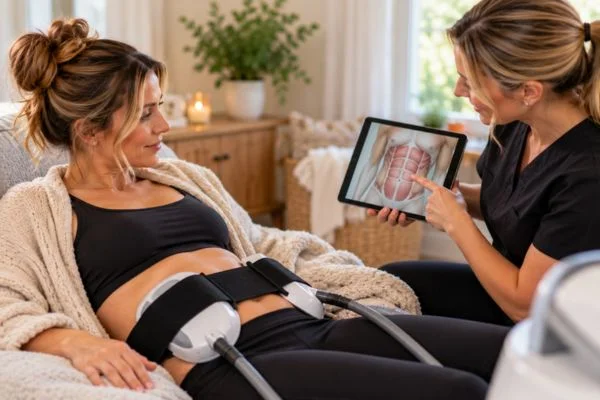
At Lipo 360, we offer consultation-led muscle stimulation treatments for suitable adults.
We do not claim that non-surgical muscle stimulation physically closes or surgically repairs separated abdominal tissue.
Treatment should not replace appropriate medical assessment or physiotherapy where indicated.
How Does Muscle Stimulation Work?
Muscle-stimulation technologies are designed to produce muscle contractions in a targeted area.
At Lipo 360, we assess suitability for treatment individually during consultation.
However, it is important to have realistic expectations.
We do not claim that muscle stimulation:
- Surgically repairs diastasis recti.
- Physically stitches or joins separated tissue
- Replaces physiotherapy
- Replaces appropriate exercise
- Treats a hernia
- Guarantees closure of an abdominal gap
- Produces a guaranteed cosmetic result
Discuss the technology, treatment area, individual circumstances, and treatment goals before considering treatment.
Is Non-Surgical Treatment an Alternative to Surgery?
It is more accurate to view them as different approaches with different purposes.
Non-surgical muscle stimulation should not be presented as producing the same result as surgical repair.
Surgery can physically repair separated abdominal structures in appropriate cases.
Muscle stimulation does not perform that surgical repair.
Similarly, physiotherapy has a different role, focusing primarily on function, movement, strength and rehabilitation.
The appropriate pathway depends on the individual’s circumstances and concerns.
Who May Consider a Lipo 360 Consultation?
An adult may choose to discuss non-surgical muscle stimulation with Lipo 360 if they are concerned about abdominal muscle tone or strength and want to understand whether a treatment may be suitable.
However, a consultation does not automatically mean we will recommend treatment.
We may advise that a medical or physiotherapy assessment is more appropriate before considering treatment.
This is particularly important where symptoms suggest that the concern may extend beyond cosmetic appearance or general muscle conditioning.
When Should You Speak to a Healthcare Professional First?
Seek appropriate healthcare advice if you have:
- Significant or unexplained abdominal pain
- A new or unexplained abdominal lump
- Suspected hernia
- Persistent or worsening symptoms
- Significant pelvic floor symptoms
- Urinary or bowel concerns
- Difficulty performing normal daily activities
- Symptoms following recent pregnancy or surgery
- Any uncertainty about what is causing your symptoms
Lipo 360 does not diagnose diastasis recti, hernias or other medical conditions.
What If You Have Recently Had a Baby?
Pregnancy and/or childbirth place significant demands on the abdominal wall, and recovery takes time.
You should not feel pressured into cosmetic treatment because your abdomen looks different following pregnancy.
If you have recently given birth, your body needs appropriate time to recover.
Medical and postnatal healthcare advice should take priority, particularly following a Caesarean section, complicated delivery or where you are experiencing pain, pelvic floor symptoms or other concerns.
Consider Lipo 360 treatment only when you have recovered sufficiently, and it is appropriate for you.
Can Lipo 360 Guarantee Results?
No.
Results from non-surgical treatments vary between individuals.
We cannot guarantee:
- Closure of an abdominal separation
- A particular reduction in the size of a gap
- A particular level of muscle development
- A flatter stomach
- A specific change in measurements
- A particular cosmetic result
We discuss individual suitability and expectations during consultation.
Which Diastasis Recti Treatment Is Right for Me?
No single treatment pathway suits everyone.
The appropriate option depends on factors including your symptoms, abdominal function, medical history, previous pregnancies or surgery and what you are hoping to address.
Broadly, the available pathways may include:
Observation and gradual recovery
Particularly during the early postpartum period, when abdominal separation may naturally reduce.
Exercise and physiotherapy
Focused on abdominal and pelvic floor function, strength and progressive rehabilitation.
Non-surgical muscle stimulation
A separate treatment option that may be considered for suitable adults after consultation, but should not be presented as physically repairing separated tissue.
Surgery
An invasive option that can include physical repair of rectus separation in appropriate cases and requires assessment by an appropriately qualified surgical professional.
These options should not be considered interchangeable.
Questions to Ask Before Choosing Treatment
Before committing to any treatment, consider asking:
- What exactly is the treatment intended to achieve?
- Is my concern primarily functional, medical or cosmetic?
- Do I need medical or physiotherapy assessment first?
- What evidence supports the treatment being recommended?
- What are the potential risks and side effects?
- What happens if I don’t have treatment?
- What results can realistically be expected?
- How long is recovery?
- Are results guaranteed?
- What alternatives are available?
Your Lipo 360 provider should be willing to discuss limitations and potential benefits.
Speak to Lipo 360
If you want to discuss whether one of Lipo 360’s non-surgical muscle-stimulation treatments is right for you, our team can arrange a consultation.
We will discuss your concerns, relevant history and what you are hoping to achieve.
If your symptoms or circumstances indicate that medical or physiotherapy assessment is more appropriate, we recommend seeking that advice before considering cosmetic treatment.
Lipo 360 does not diagnose or surgically repair diastasis recti. Non-surgical muscle stimulation should not be considered a substitute for medical care, physiotherapy or surgery where these are indicated. Treatment suitability is assessed individually, and results vary. No particular functional or cosmetic outcome can be guaranteed.
Frequently Asked Questions
What is the best treatment for diastasis recti?
There isn’t one treatment that is best for everyone. The appropriate approach depends on symptoms, abdominal function, medical history and individual circumstances. Physiotherapy or exercise rehabilitation may suit some people, while others may be considered for surgery.
Can physiotherapy treat diastasis recti?
Physiotherapy may help improve abdominal strength, control and function. A physiotherapist can assess the abdominal wall and provide an individual rehabilitation programme. Don’t assume physiotherapy will completely close an abdominal separation in everyone.
Can exercise completely close diastasis recti?
Not necessarily. Exercise can support abdominal strength and function, but it cannot guarantee a specific reduction in the abdominal gap.
Can diastasis recti be repaired without surgery?
The answer depends on what you mean by “repair”. Physiotherapy and exercise may improve strength and function without surgically joining separated tissue. Non-surgical muscle stimulation also does not perform the same structural repair as surgery.
What surgery is used for diastasis recti?
Abdominoplasty is one operation that may repair rectus muscle separation. Discuss surgical suitability, risks, expected results, and recovery with an appropriately qualified surgical professional.
Does Lipo 360 perform diastasis recti surgery?
No. Lipo 360 offers non-surgical treatment.
Does Lipo 360’s treatment close the abdominal gap?
We do not claim that muscle stimulation physically closes or surgically repairs separated abdominal tissue. Individual treatment outcomes vary.
Can muscle stimulation replace physiotherapy?
No. Muscle stimulation should not be presented as a replacement for appropriate physiotherapy or medical care.
Can treatment give me a flat stomach?
A flat stomach cannot be guaranteed. Abdominal appearance is affected by numerous factors including muscle, skin, body-fat distribution, genetics and previous pregnancy or weight changes.
Should I seek medical advice before treatment?
If you have pain, a suspected hernia, an unexplained abdominal lump, significant pelvic floor symptoms, functional problems or uncertainty about the cause of your symptoms, seek appropriate healthcare assessment before considering cosmetic treatment.